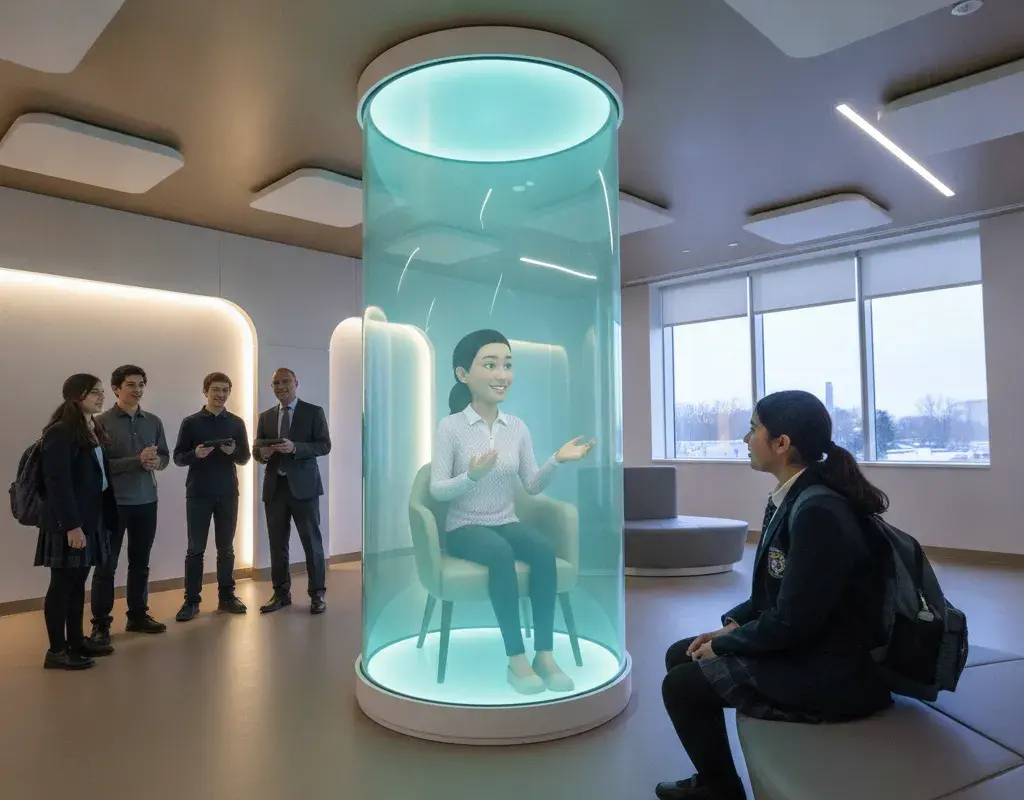
Ralph R. McKee Career and Technical Education High School is stepping out of the traditional classroom and into the future of mental healthcare. After three years of development, the Staten Island campus is preparing to open a nearly 500,000 dollar wellness studio designed to combat the rising tide of adolescent depression and anxiety. The centerpiece of the facility is a cutting edge device from Proto Hologram Inc. that allows students to consult with remote therapists via life sized, three dimensional projections, making it the first K-12 school in the world to implement this specific technology.
The initiative arrives at a critical moment for New York City youth. Recent data from the Department of Health and Mental Hygiene shows a steady decline in teen mental health over the last decade, with reports of sadness and depression climbing significantly among high schoolers. While city officials have recently pushed for limits on screen time and artificial intelligence due to their links to anxiety, Principal Gregory Bowen believes that targeted technology can actually serve as a tool for healing. He envisions the studio as a place where students can decompress from the intensity of AP courses and state exams.
Beyond the holographic consultations, the studio offers a variety of sensory experiences intended to ground stressed students. The space includes immersive screens projecting calming vistas of forests and beaches alongside beanbag chairs for relaxation. Students can also step into a recording booth to produce podcasts about teenage mental health or take to a dedicated stage to create their own holograms aimed at spreading positive messages throughout the school community. This multifaceted approach seeks to blend technical creativity with emotional support.
Despite the excitement surrounding the launch, some experts urge caution regarding the implementation of such high tech interventions. Nicholas Lanzieri, a clinical professor at NYU’s Silver School of Social Work, noted that while these tools are visually appealing, schools must be intentional so that wellness initiatives do not feel like mere science experiments. Concerns have also surfaced regarding patient privacy and cybersecurity, though Proto’s inventors insist their systems meet strict medical safety standards. As remote therapy becomes increasingly common through apps and video calls, McKee is betting that adding a physical presence through light and projection will make professional help feel more personal and accessible for its students.